
The University’s Center for Applied Artificial Intelligence at UL Lafayette (CAAI)– along with its Louisiana Center
CGI & UL Lafayette Research Team Win 2020 Government Innovation Award
Mon, 11/02/2020 - 11:49am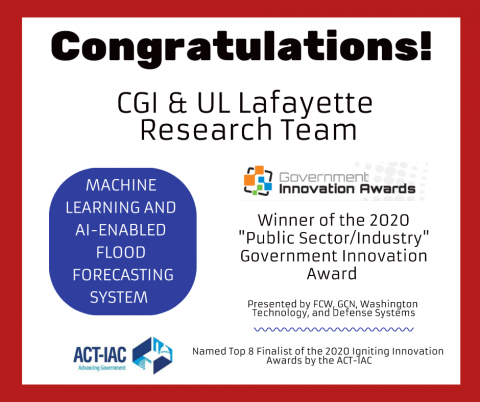
GI AND UL LAFAYETTE RESEARCHERS RECEIVE THE 2020 GOVERNMENT INNOVATION AWARD FOR FLOOD FORECASTING SYSTEM
(Lafayette, LA) The "Machine Learning and AI-Enabled Flood Forecasting" prototype was chosen among the best government IT disruptors, innovators, and emerging tech leaders in the industry. Congratulations to CGI and the University of Louisiana at Lafayette, who received the 2020 Government Innovation Award under the Public Sector/Industry category presented by FCW, GCN, Washington Technology, and Defense Systems. The award shines a light on transformative government projects with industry partners that are reimagining public-sector IT.
The Flood Forecasting system uses data mining to discover and curate large amounts of data and machine learning to interpret and "learn" from data over time. Variables like rainfall rates, river and surface water levels, soil moisture content, and other information are culled from dozens of sources, including satellites, gauges, and field sensors.
The forecasting model's capabilities aren't limited to flood prediction; the cloud-based system can be extended to make predictions about drought, landslides, wildfires, or even land usage, which are all affected by factors such as rainfall and soil moisture.
Earlier this year, the project was also recognized as a Top 8 finalist of the 2020 American Council for Technology and Industry Advisory Council Igniting Innovation Awards among 220 nominations from across the country.
CGI sponsored the project through the National Science Foundation Center for Visual and Decision Informatics (CVDI), an Industry-University Cooperative Research Center (IUCRC) at UL Lafayette that develops tools and techniques that significantly improve the way an organization's data is organized and interpreted.
"Multiple recognitions are a great testament to our CVDI model," said Sumit Shah, Chief Data Scientist at CGI. A longtime member of CVDI with leadership on the Industry Advisory Board, CGI is a strong advocate for public-private partnerships and exploring new ways to accelerate innovation.
Each year, partner universities such as the University of Virginia, Stony Brook University, Tampere University in Finland, Drexel University, and the University of North Carolina at Charlotte complete around 20 projects a year. The faculty works directly with 16 industry members such as TietoEVRY, U.S. Geological Survey, Leidos, U.S. Army Geospatial Center, MedPod and Zeblok, Inc. Since its launch in 2012, the center has allocated over 15 million dollars in industry-funded research.
Shah is grateful for the dedicated team of researchers, led by Dr. Emad Habib and Dr. Mohamed Elsaadani with the College of Electrical and Computer Engineering/Institute for Coastal and Water Research. He explained, "There is great value in working with the university that gives us access to such diverse cross-disciplinary expertise to solve very complex problems."
Habib acknowledges the unique collaborative approaches offered by CVDI and its industry sponsors to tackle new societal problems. "Recent technologies in data sciences and machine learning, coupled with the unprecedented growth in environmental data from nontraditional sources, open the door for innovative approaches that can help our communities become more resilient. Our project aspires to make significant contributions towards fulfilling this vision". The project also provided unique training opportunities for graduate students, including Ph.D. candidate Ahmed Abdelhameed from the Department of Electrical and Computer Engineering.
The UL Lafayette research team contributions included faculty and students from the Department of Civil Engineering, Louisiana Watershed Flood Center, Institute for Coastal and Water Research, and Department of Electrical and Computer Engineering.
The 2020 Government Innovation Award winners were announced last week, but due to COVID-19, the ceremony was canceled. The winners will be profiled by Washington Technology.com and appear in the November/December print issue of FWC.
###