You are here

NSF survey puts University in top 10 in U.S. for industry-funded research

Top Stories

Register for the Disaster Response/Geospatial Data Mining Workshop

The workshop hosts speakers from federal, state, and private response teams and is attended by geospatial emergency

Read More ➝

Williams shares his journey from ITech to emergency management with students

Jim Williams, our Public-Private Partnership Officer, was invited to the monthly meeting of the Association of Techn

Read More ➝

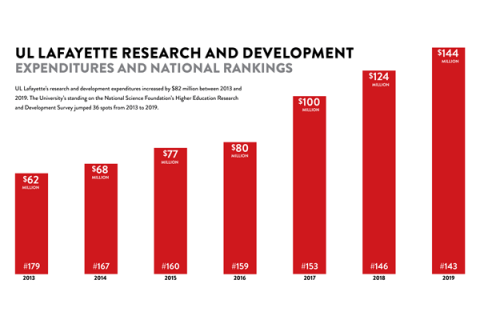
The University of Louisiana at Lafayette is ranked 143rd in the nation for research and development expenditures.

UL Lafayette is also among the top 10 universities in the United States for research that’s funded through partnerships with business and industry.

Both pieces of good news can be found in the Higher Education Research and Development, or HERD, Survey, the National Science Foundation’s annual index of research expenditures.

NSF released its 2019 rankings earlier this month. UL Lafayette’s showing is based on the record $144.2 million it expended on R&D during the fiscal year that ended June 30, 2019.

The amount places the University among the top 22% of the 647 U.S. colleges and universities the 2019 HERD survey included.

The 2019 figure is a 15% increase over the previous year’s total of $124.7 million. UL Lafayette’s R&D expenditures in 2018 placed the University at 146th on the HERD index.

UL Lafayette competes against other universities for federal and state government grants, and private sector contracts. The University acts as a steward for the funds awarded to faculty and staff researchers.

Slightly more than 33.5% of the $144.2 million the University expended on R&D in 2019 was funded through industry partnerships, the HERD index showed. That total – $48.3 million – puts UL Lafayette in the top 10 for industry-funded research.

Among those 10 universities, UL Lafayette’s overall HERD ranking – 143rd – is the highest.

In 2013, the University spent $62 million in R&D and ranked 179th in the nation. By 2017, the University increased its expenditures to $100.98 million; its ranking was 153rd that year. The 2017 figure was the first time in UL Lafayette history that its R&D expenditures crossed the $100 million threshold.

Dr. Joseph Savoie, UL Lafayette president, announced the 2019 total during his annual State of the University speech in August, but NSF did not release final rankings until this month.  

The $144.2 million figure marks a 133% increase in six years, Savoie noted. The University jumped 36 spots in the rankings during the same period.

“Each research and development partnership we create with the private sector and with the state and federal governments helps sustain the momentum we’ve been building over the past several years,” Savoie said.

Dr. Ramesh Kolluru is vice president for Research, Innovation and Economic Development at UL Lafayette. He said recently the 2019 HERD ranking “could not have happened without the determination and passion of our faculty, research staff, and graduate students as well as the administrative staff members throughout the University who support them.”

“Our ability to continue to attract this level of R&D funding is a testament to the brainpower we have here. The hard work of our researchers has enabled the University to demonstrate – and deepen – its commitment to ‘research for a reason.’ The public impact of our research is felt locally, nationally and globally.”

Graphic credit: Courtney Jeffries / University of Louisiana at Lafayette

SHARE THIS |

Learn More About Our Research Centers

Accessible Healthcare through AI-Augmented Decisions

The National Science Foundation approved the Accessible Healthcare for AI-Augmented Decisions (AHeAD) Center to move forward with planning in July 2025. Its mission brings university researchers and healthcare industry stakeholders together to conduct foundational research needed to create usable AI-augmented decision support tools that enhance healthcare delivery, improve patient outcomes, and reduce costs.AHeAD is a multi-university research partnership between UL Lafayette (lead), Tulane University, the University of Florida, and Georgia Tech. Tampere University in Finland has expressed interest in becoming a university partner.

Meet AHeAD Director, Dr. Raju Gottumukkala


Center for Applied Artificial Intelligence

The Center for Applied Artificial Intelligence (CAAI) is dedicated to pursuing use-driven AI research, training an AI-ready workforce, and creating a platform to accelerate innovation to support the local economy. The center serves as a hub where AI researchers, domain experts from diverse disciplines, industry specialists, and community stakeholders come together to address real-world challenges.

Meet CAAI Director, Raju Gottumukkala, PhD.


Center for Critical Infrastructure Cybersecurity (CCIC)

The Center for Critical Infrastructure Cybersecurity (CCIC) brings together multiple and diverse experts from across the University to help our nation prepare for cyberattacks that may impact the country's critical infrastructure.CCIC was founded to examine cybersecurity from the perspective of the cascading impact of a significant cyber incident on the nation’s critical infrastructure, such as that experienced by the 2015 cyberattack on the Ukrainian Power Grid. The Center for the Study of Existential Risk at Cambridge University, UK, now places cyberattacks as a “blue sky hazard” that can take an entire power grid down for a prolonged period. A consequence of such an attack would extend beyond the loss of data; it could completely disrupt the functioning of society, much like a large-scale natural disaster.

 Meet CCIC Director Arun Lakhotia, PhD

Louisiana Business Emergency Operations Center

The NIMSAT Institute manages the daily operations of the Louisiana Business Emergency Operations Center (LABEOC). The center assists Louisiana businesses and non-profit organizations in disaster preparedness, response, and recovery efforts to ensure community stability, resilience, and economic revitalization.

Louisiana Center for Health Innovation

The Louisiana Center for Health Innovation (LCHI) is dedicated to advancing healthcare innovation by developing research, education, and engagement activities that foster collaboration among academia, industry, and the community. This commitment aims to improve healthcare outcomes, promote health equity, and develop a skilled workforce that meets the needs of Louisiana and beyond.


Learn more about LCHI and meet the Director, Gabriela Wilson, PhD, MSc, FHIMSS, FIAHSI, SNAI.


National Incident Management Systems and Advanced Technologies

The National Incident Management Systems and Advanced Technologies (NIMSAT) Institute focuses on enriching public-private partnerships and advanced information technologies to enhance the national resiliency for a full range of potential disasters. Our mission is to save human lives. Our experienced emergency management team joins university researchers and technology experts to build a more resilient America through education, training, outreach, and operational support, empowering the homeland security and emergency management community.