
The University’s Center for Applied Artificial Intelligence at UL Lafayette (CAAI)– along with its Louisiana Center
UL Lafayette celebrates R1 status, far-reaching significance of designation
Wed, 03/02/2022 - 2:08pm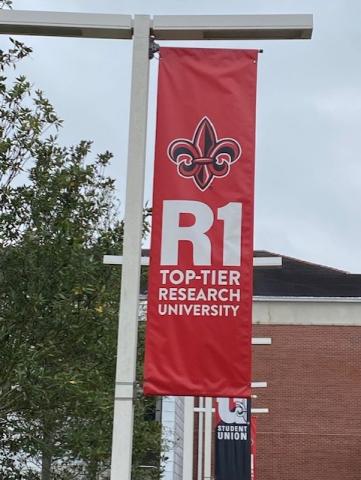
University of Louisiana at Lafayette faculty and staff members, students, and public officials gathered Wednesday to celebrate its recent designation as a Carnegie R1 university.
The event was structured to convey the importance of that status, which constitutes a prestigious pat on the back and cements UL Lafayette’s position as a top-tier research institution. The designation will spur economic development, attract high-quality students and faculty members, and help increase external funding for the University.
It is the loftiest designation bestowed by the Carnegie Classification of Institutions of Higher Education, the leading framework for describing colleges and universities in the U.S. The Carnegie Classification’s 2021 update includes nearly 3,900 institutions. Only 137 of them, or 3%, attained R1 status.
UL Lafayette is among them.
Faculty, staff and student researchers helped drive that point home during a research showcase held inside the UL Lafayette Student Union that accompanied the celebration. They provided crash courses about the work they’re doing that contributed to the University’s R1 status, and the exhibits touched on research in nearly every academic college, Graduate School and in University research centers.
Reminders were also evident in the green space outside the Student Union, where throngs of students, faculty and staff members, and public officials gathered to learn about the significance of the R1 designation.
UL Lafayette’s status as a top-tier university will benefit the University, the community and the state, explained Dr. Ramesh Kolluru, the University’s vice president for Research, Innovation and Economic Development.
“It means an institution is a national and global leader that has met all of the benchmarks in externally funded research, in the number of doctoral degrees that it awards every year, and in terms of the high-quality number of research staff that the University employs,” Kolluru said.
Dr. Joseph Savoie, UL Lafayette president, said the designation represents a longstanding commitment to remaining at the forefront of learning, innovation and scholarship.
“Achieving R1 reflects these values and affirms these commitments. As their stewards, it’s our duty to build upon them. In the same way that we stand on the shoulders of those who went before us, we must seize this moment of opportunity so that those who come after us can reach even greater heights,” Savoie said.
Dr. Jim Henderson, University of Louisiana System president, agreed, saying R1 status signifies “a milestone on the way to what this university is going to be.”
“This is a change-making university,” Henderson added.
A top-tier research university fosters workforce and economic development. It’s enticing to businesses that seek an established source of intellectual capital. The status appeals to external agencies and policymakers who make funding decisions. It also makes faculty members more competitive when seeking grants or to collaborate with public or private sector partners.
U.S. Sen. Bill Cassidy, speaking during the celebration, said “the way to create a great state is to create a great university. The R1 designation is a comment on where UL Lafayette has come from. It is a prediction of where it will go.”
That trajectory includes attracting and retaining students eager to enroll at an institution where academic excellence is underscored by opportunities to engage in cutting-edge research.
Bimi Shrestha, a doctoral student in systems engineering, is one such student. She is contributing to a multidisciplinary NASA research project that centers on a biorefinery system built at UL Lafayette. The system is designed to convert waste generated in space into life-sustaining products such as potable water, breathable air and energy.
“I couldn’t be more proud of where I will earn my Ph.D. Being an R1 institution is the outcome of hard work by the faculty, staff and students involved in research,” Shrestha said.