You are here

University expands informatics offerings to help meet industry demand

Top Stories

Register for the Disaster Response/Geospatial Data Mining Workshop

The workshop hosts speakers from federal, state, and private response teams and is attended by geospatial emergency

Read More ➝

Williams shares his journey from ITech to emergency management with students

Jim Williams, our Public-Private Partnership Officer, was invited to the monthly meeting of the Association of Techn

Read More ➝

PUBLISHED August 2, 2023

The University of Louisiana at Lafayette has added three new graduate concentrations for people interested in changing careers or advancing in technological roles.

Students seeking a master’s degree in informatics from UL Lafayette’s Ray P. Authement College of the Sciences can now choose from concentrations in cybersecurity, data science and health informatics. That’s in addition to the existing informatics generalist concentration.

The 33-credit-hour master’s in informatics degree offers thesis and non-thesis tracks. Core courses cover human-computer interaction, network infrastructures, systems development, IT security, data analysis and visualization, distributed databases, cloud computing and big data applications.

The University established the master’s in informatics degree program in 2018. In 2021, it began offering the master’s degree online, along with the existing on-campus format.

“As a graduate school and a university, we’re committed to research and to helping students apply that research in programs that fit into their lives,” said Dr. Mary Farmer-Kaiser, dean of the Graduate School. “Delivering a top-tier curriculum on campus and online is one of the many ways we’re demonstrating those values.”

The three new concentrations are strategic additions designed to meet student needs and industry demands, and to maximize opportunities for graduates, said Dr. Martin Margala, a professor who directs the School of Computing and Informatics.

“Technology and the needs surrounding technology are constantly changing. It’s critical that we’re responsive to those changes to best prepare students for workforce needs,” Margala said.

According to the U.S. Bureau of Labor Statistics, demand for roles related to the master’s program’s three new concentrations are growing faster than average. This includes positions as information security analysts, data scientists, information systems managers, health information technologists, database administrators and computer systems analysts.

Informatics is widely applicable because computing skills are critical across industries, said Dr. Azmy S. Ackleh, dean of the Ray P. Authement College of Sciences, which includes the School of Computing and Informatics.

“By definition, informatics is applied computing across multiple domains – business, health sciences, engineering,” he said. “Our informatics graduates are in high demand and have received outstanding career opportunities in industry from companies and organizations across the board at competitive salaries.”

Dr. Michael Totaro, graduate coordinator and an associate professor in the School of Computing and Informatics, said the cross-disciplinary nature of informatics means students can leverage their existing knowledge. That includes, he added, students who don’t have a technical background prior to starting their informatics program of study.

“Students can merge the area of expertise that they already have and the expertise they're going to develop in informatics,” Totaro said. “Everything that you've learned, everything that you've done, can be useful to you.”

Learn more at the School of Computing and Informatics website.

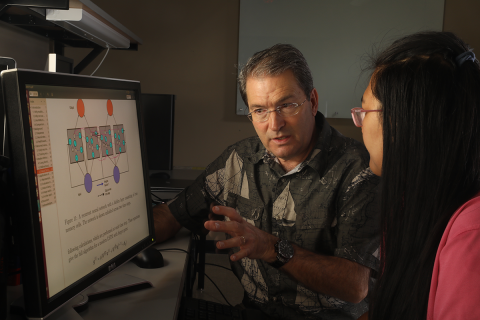
Photo caption: UL Lafayette has added three new concentrations to its master’s degree in informatics, additions that are designed to meet workforce needs. Photo credit: Doug Dugas / University of Louisiana at Lafayette

SHARE THIS |

Learn More About Our Research Centers

Accessible Healthcare through AI-Augmented Decisions

The National Science Foundation approved the Accessible Healthcare for AI-Augmented Decisions (AHeAD) Center to move forward with planning in July 2025. Its mission brings university researchers and healthcare industry stakeholders together to conduct foundational research needed to create usable AI-augmented decision support tools that enhance healthcare delivery, improve patient outcomes, and reduce costs.AHeAD is a multi-university research partnership between UL Lafayette (lead), Tulane University, the University of Florida, and Georgia Tech. Tampere University in Finland has expressed interest in becoming a university partner.

Meet AHeAD Director, Dr. Raju Gottumukkala


Center for Applied Artificial Intelligence

The Center for Applied Artificial Intelligence (CAAI) is dedicated to pursuing use-driven AI research, training an AI-ready workforce, and creating a platform to accelerate innovation to support the local economy. The center serves as a hub where AI researchers, domain experts from diverse disciplines, industry specialists, and community stakeholders come together to address real-world challenges.

Meet CAAI Director, Raju Gottumukkala, PhD.


Center for Critical Infrastructure Cybersecurity (CCIC)

The Center for Critical Infrastructure Cybersecurity (CCIC) brings together multiple and diverse experts from across the University to help our nation prepare for cyberattacks that may impact the country's critical infrastructure.CCIC was founded to examine cybersecurity from the perspective of the cascading impact of a significant cyber incident on the nation’s critical infrastructure, such as that experienced by the 2015 cyberattack on the Ukrainian Power Grid. The Center for the Study of Existential Risk at Cambridge University, UK, now places cyberattacks as a “blue sky hazard” that can take an entire power grid down for a prolonged period. A consequence of such an attack would extend beyond the loss of data; it could completely disrupt the functioning of society, much like a large-scale natural disaster.

 Meet CCIC Director Arun Lakhotia, PhD

Louisiana Business Emergency Operations Center

The NIMSAT Institute manages the daily operations of the Louisiana Business Emergency Operations Center (LABEOC). The center assists Louisiana businesses and non-profit organizations in disaster preparedness, response, and recovery efforts to ensure community stability, resilience, and economic revitalization.

Louisiana Center for Health Innovation

The Louisiana Center for Health Innovation (LCHI) is dedicated to advancing healthcare innovation by developing research, education, and engagement activities that foster collaboration among academia, industry, and the community. This commitment aims to improve healthcare outcomes, promote health equity, and develop a skilled workforce that meets the needs of Louisiana and beyond.


Learn more about LCHI and meet the Director, Gabriela Wilson, PhD, MSc, FHIMSS, FIAHSI, SNAI.


National Incident Management Systems and Advanced Technologies

The National Incident Management Systems and Advanced Technologies (NIMSAT) Institute focuses on enriching public-private partnerships and advanced information technologies to enhance the national resiliency for a full range of potential disasters. Our mission is to save human lives. Our experienced emergency management team joins university researchers and technology experts to build a more resilient America through education, training, outreach, and operational support, empowering the homeland security and emergency management community.