You are here

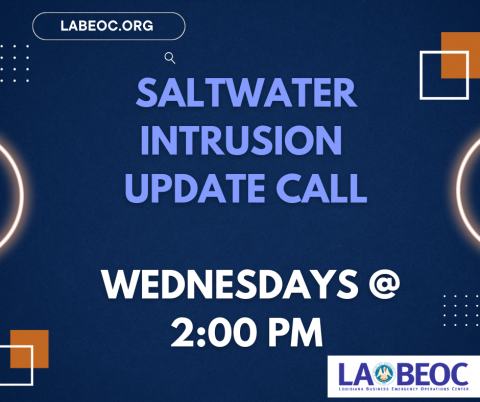
LABEOC Private Sector Call - Saltwater Intrusion on the Lower Mississippi

Top Stories

Register for the Disaster Response/Geospatial Data Mining Workshop

The workshop hosts speakers from federal, state, and private response teams and is attended by geospatial emergency

Read More ➝

Williams shares his journey from ITech to emergency management with students

Jim Williams, our Public-Private Partnership Officer, was invited to the monthly meeting of the Association of Techn

Read More ➝

The LABEOC is monitoring the increased threat of saltwater intrusion in the Mississippi River. GOHSEP is now operating at a Level-3 Activation with select agencies.

 
The LABEOC has coordinated with GOHSEP to combine the GOHSEP logistics coordination meeting with the LABEOC private sector update concerning the saltwater intrusion in the greater New Orleans area. The updates will be hosted by the LABEOC, but GOHSEP operations will participate in the calls.  This call will replace the Friday call that was previously held and will continue while the threat to the water systems in New Orleans remains.

The LABEOC invites you to a scheduled Zoom meeting concerning the saltwater intrusion in the Greater New Orleans Area.

Wednesday, October 4
2:00 pm – 3:00 pm CDT
(Recurring weekly)

Thank you,

Jim Williams, MBA
Public-Private Partnership Operations Officer
Louisiana Business Emergency Operations Center
Informatics Research Institute
University of Louisiana at Lafayette – A Carnegie R1 Research University
Office: (337) 482-0633
Cell: (337) 422-9169
james.williams@louisiana.edu
www.labeoc.org


———

Zoom Call Information
Join Zoom Meeting
https://us06web.zoom.us/j/89283900956?pwd=BodK7xeww83iyIpvMZ7gXadK018QKF.1
Meeting ID: 892 8390 0956
Passcode: 614006

One tap mobile
+16469313860,,89283900956#,,,,*614006# US
+19292056099,,89283900956#,,,,*614006# US (New York)

Dial by your location
• +1 646 931 3860 US
• +1 929 205 6099 US (New York)
• +1 301 715 8592 US (Washington DC)
• +1 305 224 1968 US
• +1 309 205 3325 US
• +1 312 626 6799 US (Chicago)
• +1 360 209 5623 US
• +1 386 347 5053 US
• +1 507 473 4847 US
• +1 564 217 2000 US
• +1 669 444 9171 US
• +1 669 900 6833 US (San Jose)
• +1 689 278 1000 US
• +1 719 359 4580 US
• +1 253 205 0468 US
• +1 253 215 8782 US (Tacoma)
• +1 346 248 7799 US (Houston)

Meeting ID: 892 8390 0956
Passcode: 614006

Find your local number: https://us06web.zoom.us/u/kdxHsKq0G4

.
Please remember to check out our news alerts on labeoc.org and follow our social media for updates @LABEOC.

SHARE THIS |

Learn More About Our Research Centers

Accessible Healthcare through AI-Augmented Decisions

The National Science Foundation approved the Accessible Healthcare for AI-Augmented Decisions (AHeAD) Center to move forward with planning in July 2025. Its mission brings university researchers and healthcare industry stakeholders together to conduct foundational research needed to create usable AI-augmented decision support tools that enhance healthcare delivery, improve patient outcomes, and reduce costs.AHeAD is a multi-university research partnership between UL Lafayette (lead), Tulane University, the University of Florida, and Georgia Tech. Tampere University in Finland has expressed interest in becoming a university partner.

Meet AHeAD Director, Dr. Raju Gottumukkala


Center for Applied Artificial Intelligence

The Center for Applied Artificial Intelligence (CAAI) is dedicated to pursuing use-driven AI research, training an AI-ready workforce, and creating a platform to accelerate innovation to support the local economy. The center serves as a hub where AI researchers, domain experts from diverse disciplines, industry specialists, and community stakeholders come together to address real-world challenges.

Meet CAAI Director, Raju Gottumukkala, PhD.


Center for Critical Infrastructure Cybersecurity (CCIC)

The Center for Critical Infrastructure Cybersecurity (CCIC) brings together multiple and diverse experts from across the University to help our nation prepare for cyberattacks that may impact the country's critical infrastructure.CCIC was founded to examine cybersecurity from the perspective of the cascading impact of a significant cyber incident on the nation’s critical infrastructure, such as that experienced by the 2015 cyberattack on the Ukrainian Power Grid. The Center for the Study of Existential Risk at Cambridge University, UK, now places cyberattacks as a “blue sky hazard” that can take an entire power grid down for a prolonged period. A consequence of such an attack would extend beyond the loss of data; it could completely disrupt the functioning of society, much like a large-scale natural disaster.

 Meet CCIC Director Arun Lakhotia, PhD

Louisiana Business Emergency Operations Center

The NIMSAT Institute manages the daily operations of the Louisiana Business Emergency Operations Center (LABEOC). The center assists Louisiana businesses and non-profit organizations in disaster preparedness, response, and recovery efforts to ensure community stability, resilience, and economic revitalization.

Louisiana Center for Health Innovation

The Louisiana Center for Health Innovation (LCHI) is dedicated to advancing healthcare innovation by developing research, education, and engagement activities that foster collaboration among academia, industry, and the community. This commitment aims to improve healthcare outcomes, promote health equity, and develop a skilled workforce that meets the needs of Louisiana and beyond.


Learn more about LCHI and meet the Director, Gabriela Wilson, PhD, MSc, FHIMSS, FIAHSI, SNAI.


National Incident Management Systems and Advanced Technologies

The National Incident Management Systems and Advanced Technologies (NIMSAT) Institute focuses on enriching public-private partnerships and advanced information technologies to enhance the national resiliency for a full range of potential disasters. Our mission is to save human lives. Our experienced emergency management team joins university researchers and technology experts to build a more resilient America through education, training, outreach, and operational support, empowering the homeland security and emergency management community.