You are here

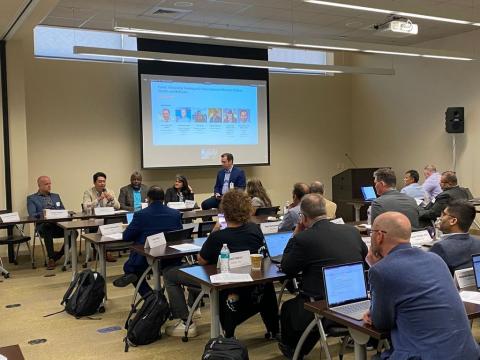
Invitation to Collaborative Workshop: Exploring the Transformative Impact of Applied AI on Healthcare

Top Stories

Register for the Disaster Response/Geospatial Data Mining Workshop

The workshop hosts speakers from federal, state, and private response teams and is attended by geospatial emergency

Read More ➝

Williams shares his journey from ITech to emergency management with students

Jim Williams, our Public-Private Partnership Officer, was invited to the monthly meeting of the Association of Techn

Read More ➝

Exploring the Transformative Impact of Applied AI on Healthcare Workshop

April 23, 2024, 8:30 am – 2:15 pm

Center for Academic Excellence, Ochsner Main Campus, Classrooms 1- 3
1401-A Jefferson Highway, 1st Floor
New Orleans, LA 70121

Based on your expertise and interest in AI and health, you are invited to a workshop designed to explore how AI, augmented by human insight, can profoundly improve health outcomes.  

Despite the highest healthcare spending, the U.S. has poorer health outcomes compared to other high-income countries, with Louisiana ranking low on many health indicators ranging from chronic diseases to behavioral health. AI holds the promise of enabling quicker and better-informed decision-making for patients, doctors, and policymakers, and it can enhance health behaviors by a better-managing individual to population health.

The workshop's goal is to bring in interdisciplinary experts (e.g., physicians, health policy experts, public health scholars, and AI researchers) to help understand thechallenges posed by fragmented information infrastructure from multiple perspectives, gaps in patient behavior sensing, and how these issues affect health outcomes. The workshop will foster collaboration between AI researchers and health experts to jointly identify challenge areas, sources of funding, and collaborative research opportunities.

Objectives: The workshop is structured around the following objectives:

Learning from Healthcare Organizations: Understand the health challenges with care fragmentation and gaps that contribute to poor decisions and thereby lead to unfavorable health outcomes, including but not limited to transitions of care, patient engagement, patient monitoring, health disparities, and access to rural healthcare.

Showcasing Ongoing AI/ML Research: Present ongoing and pertinent research endeavors in the various topics of Artificial Intelligence and Machine Learning with respect to how to make AI explainable, how we improve methods to measure patient behavior, how to build AI on top of fragmented infrastructure.

Identifying Synergies: Explore potential synergies between AI expertise and addressing

the challenges impeding optimal health outcomes.

Developing Use-Driven Research Problem Statements: Collaboratively formulate research problem statements grounded in practical applications and real-world healthcare needs.

Uniting stakeholders from various disciplines, we can foster a comprehensive understanding of the intersection between AI and healthcare, thereby paving the way for innovative solutions to pressing healthcare challenges.

We look forward to your participation and contributions to this transformative dialogue.


Participants

Academic Institutions:

  • University of Louisiana at Lafayette
  • Tulane University 
  • Georgia Tech
  • LSU Health Sciences Center, New Orleans
  • University of Florida

State Agencies:

  • Louisiana Department of Health

Industry:

  • Ochsner Health
  • Google
  • CGI
  • Aetna 
  • Haltian Inc
  • OneTeleMed (Telemedicine)

Read more

SHARE THIS |

Learn More About Our Research Centers

Accessible Healthcare through AI-Augmented Decisions

The National Science Foundation approved the Accessible Healthcare for AI-Augmented Decisions (AHeAD) Center to move forward with planning in July 2025. Its mission brings university researchers and healthcare industry stakeholders together to conduct foundational research needed to create usable AI-augmented decision support tools that enhance healthcare delivery, improve patient outcomes, and reduce costs.AHeAD is a multi-university research partnership between UL Lafayette (lead), Tulane University, the University of Florida, and Georgia Tech. Tampere University in Finland has expressed interest in becoming a university partner.

Meet AHeAD Director, Dr. Raju Gottumukkala


Center for Applied Artificial Intelligence

The Center for Applied Artificial Intelligence (CAAI) is dedicated to pursuing use-driven AI research, training an AI-ready workforce, and creating a platform to accelerate innovation to support the local economy. The center serves as a hub where AI researchers, domain experts from diverse disciplines, industry specialists, and community stakeholders come together to address real-world challenges.

Meet CAAI Director, Raju Gottumukkala, PhD.


Center for Critical Infrastructure Cybersecurity (CCIC)

The Center for Critical Infrastructure Cybersecurity (CCIC) brings together multiple and diverse experts from across the University to help our nation prepare for cyberattacks that may impact the country's critical infrastructure.CCIC was founded to examine cybersecurity from the perspective of the cascading impact of a significant cyber incident on the nation’s critical infrastructure, such as that experienced by the 2015 cyberattack on the Ukrainian Power Grid. The Center for the Study of Existential Risk at Cambridge University, UK, now places cyberattacks as a “blue sky hazard” that can take an entire power grid down for a prolonged period. A consequence of such an attack would extend beyond the loss of data; it could completely disrupt the functioning of society, much like a large-scale natural disaster.

 Meet CCIC Director Arun Lakhotia, PhD

Louisiana Business Emergency Operations Center

The NIMSAT Institute manages the daily operations of the Louisiana Business Emergency Operations Center (LABEOC). The center assists Louisiana businesses and non-profit organizations in disaster preparedness, response, and recovery efforts to ensure community stability, resilience, and economic revitalization.

Louisiana Center for Health Innovation

The Louisiana Center for Health Innovation (LCHI) is dedicated to advancing healthcare innovation by developing research, education, and engagement activities that foster collaboration among academia, industry, and the community. This commitment aims to improve healthcare outcomes, promote health equity, and develop a skilled workforce that meets the needs of Louisiana and beyond.


Learn more about LCHI and meet the Director, Gabriela Wilson, PhD, MSc, FHIMSS, FIAHSI, SNAI.


National Incident Management Systems and Advanced Technologies

The National Incident Management Systems and Advanced Technologies (NIMSAT) Institute focuses on enriching public-private partnerships and advanced information technologies to enhance the national resiliency for a full range of potential disasters. Our mission is to save human lives. Our experienced emergency management team joins university researchers and technology experts to build a more resilient America through education, training, outreach, and operational support, empowering the homeland security and emergency management community.